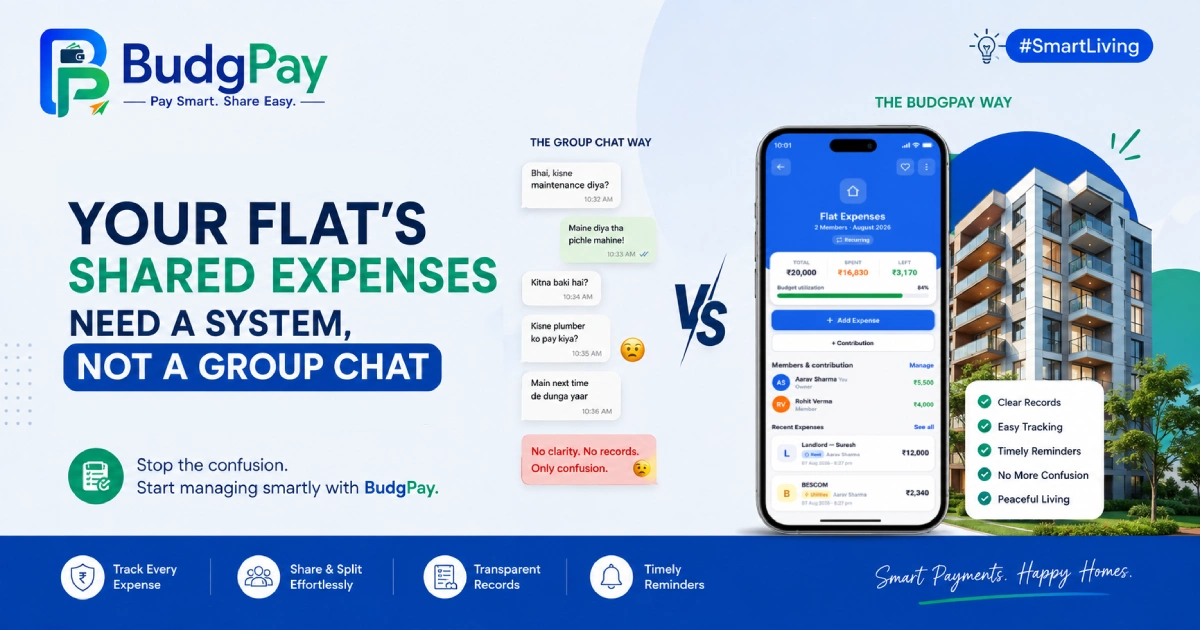
Most flats don't decide to get a system. They just keep patching the current non-system - a group chat, some mental math, a vague sense of who paid last - until one of these six things happens enough times that somebody finally says "we need to actually track this."
1. Someone always "forgets" to pay back
Not maliciously - genuinely forgets, because the only record of the debt was a message sent eleven days ago that's since scrolled past a hundred other messages about dinner plans and a broken geyser. When the only ledger is a chat history, "forgetting" isn't a character flaw, it's the predictable result of the format. A chat is built for conversation, not for holding a running balance anyone can check later.
2. Nobody actually knows the real grocery total
Someone did a big grocery run three weeks ago. Someone else did a smaller top-up run last week. A third person grabbed a few things on the way home twice. Ask any of the three flatmates "what's the total grocery spend this month, and what's my share," and you'll get three different rough guesses, none of which anyone's confident in. This isn't a sign anyone's bad with money - it's a sign the information was never in one place to begin with.
3. There's a recurring dispute about who bought what
"I definitely paid for that" / "no you didn't, I did" is a specific, recognizable argument, and it happens for a specific reason: two people both have a vague memory of paying, and neither memory is backed by anything checkable. This particular fight is almost always resolvable in ten seconds if there's a timestamped log anyone can point to - and almost never resolvable without one, because it becomes a memory contest instead of a fact check.
4. A new flatmate has zero visibility into how things have historically worked
Someone moves in three months into an established flat-share, and the "system" that's been informally working for the existing flatmates is entirely invisible to them - there's no history to look at, no explanation beyond "we just kind of know," and the new person is left guessing at unwritten rules. If the system only lives in three people's heads, it's not actually a system - it's tribal knowledge that doesn't survive contact with anyone new.
5. The WhatsApp math thread is 200 messages long
Every flat with an informal system eventually has one of these: a thread that started as "quick note on who owes what" and is now a scroll-fest of partial calculations, corrections, "wait I think I made an error above," and nobody wanting to be the one to scroll up and re-derive the current total. By the time a thread is 200 messages deep, re-establishing ground truth is genuinely more work than it should ever be for tracking household expenses.
6. Someone quietly dreads the end-of-month settle-up conversation
This is the sign that's easiest to miss, because it doesn't look like a problem from the outside - nobody's arguing, nothing's visibly broken. But if the monthly "okay, let's figure out who owes what" conversation is something one or more flatmates privately brace for, that's a real cost, even though it never shows up as an actual dispute. Dread is what happens when someone expects a conversation to be tedious or tense, based on how the last several went - and it's a completely reasonable reaction to a system that's made every previous settle-up harder than it needed to be.
If settling up were actually easy - one number, agreed by everyone, no reconstruction required - there'd be nothing to dread. The dread itself is a signal that the underlying system, not any specific person, is the thing making this harder than it should be.
None of this is a flatmate problem
Every one of these six signs looks, on the surface, like a people problem - someone forgetful, someone careless, someone bad at replying, someone who hates confrontation. It isn't. It's what happens, reliably, when the tool being used (memory, a chat thread) was never built to hold a running number that updates and stays checkable. Fix the tool, and most of this friction disappears on its own - not because anyone became more responsible, but because the information stopped depending on anyone's memory in the first place.
What actually changes once you fix it
The difference isn't dramatic day to day - nobody throws a party because expense tracking got easier. It shows up in smaller ways: the end-of-month settle-up becomes a thirty-second glance at a number everyone already agrees on, instead of a reconstruction project. A new flatmate can see exactly how things have been running since they moved in, instead of learning by osmosis. And the specific, recognizable "I definitely paid for that" argument mostly just... stops happening, because there's a timestamped log to check instead of two competing memories.
None of that requires anyone in the flat to become more organized or more responsible. It just requires the running total to live somewhere other than someone's memory and a chat thread that was never built to hold it.